Why LandLedger?
In humanitarian crises, land and property are more than physical assets: they are anchors of identity, stability, and recovery.
Yet in many contexts, the majority of people hold land through informal or customary arrangements that are never captured in official systems.
When disasters or conflicts strike, these invisible forms of tenure leave millions without proof of where they belong or what they’ve lost.
This invisibility undermines not only people’s rights, but also the ability of humanitarian actors to deliver effective, equitable assistance.
LandLedger changes that. It provides a simple, people-centered way to make existing tenure arrangements visible and traceable, even when no formal documentation exists. By recording the stories behind how families occupy, inherit, or share land, LandLedger creates a living record that protects claims and strengthens the evidence base for response and recovery.
Protection and Evidence
Targeting Assistance
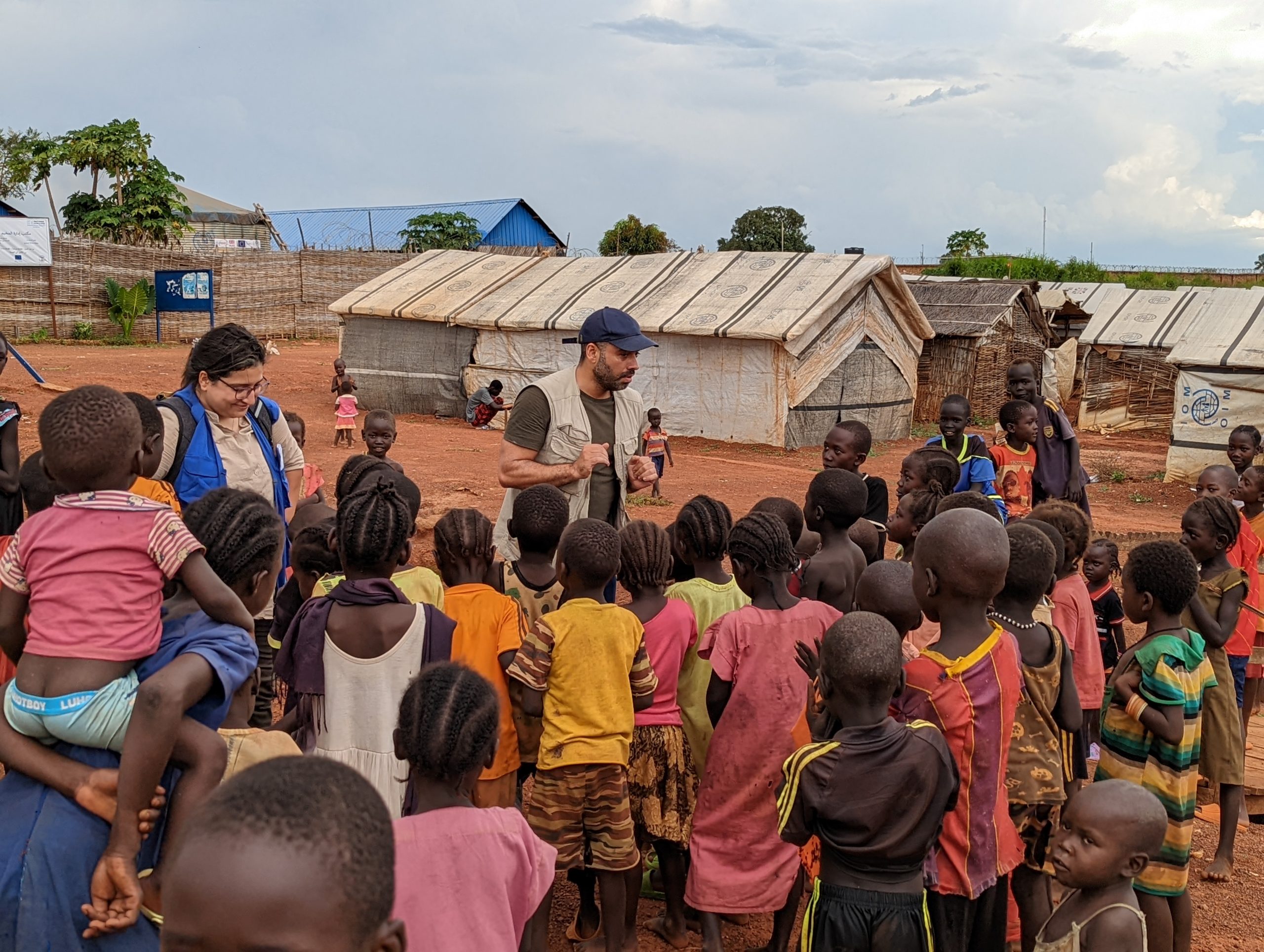
In displacement responses, understanding who lives where, and under what type of arrangement, is essential for shelter support, compensation, or relocation planning. LandLedger provides a lightweight, scalable way to map informal tenure patterns, enabling agencies to target assistance more accurately and transparently.
Supporting Returns and Recovery
In post-conflict settings such as Syria, Sudan, and Ethiopia, where formal land registries have been destroyed, manipulated, or made inaccessible, LandLedger could allow displaced families to preserve proof of ownership and occupancy through stories, documents, and community testimonies. These digital records can later support restitution and return processes by offering prima-facie, time-stamped evidence of prior rights.
Ultimately, LandLedger adds a missing layer of truth to humanitarian operations — one that combines narrative, evidence, and place. It recognizes that behind every parcel of land lies a human story, and that acknowledging those stories is key to designing responses that are not only efficient, but just.
LandLedger Methodology
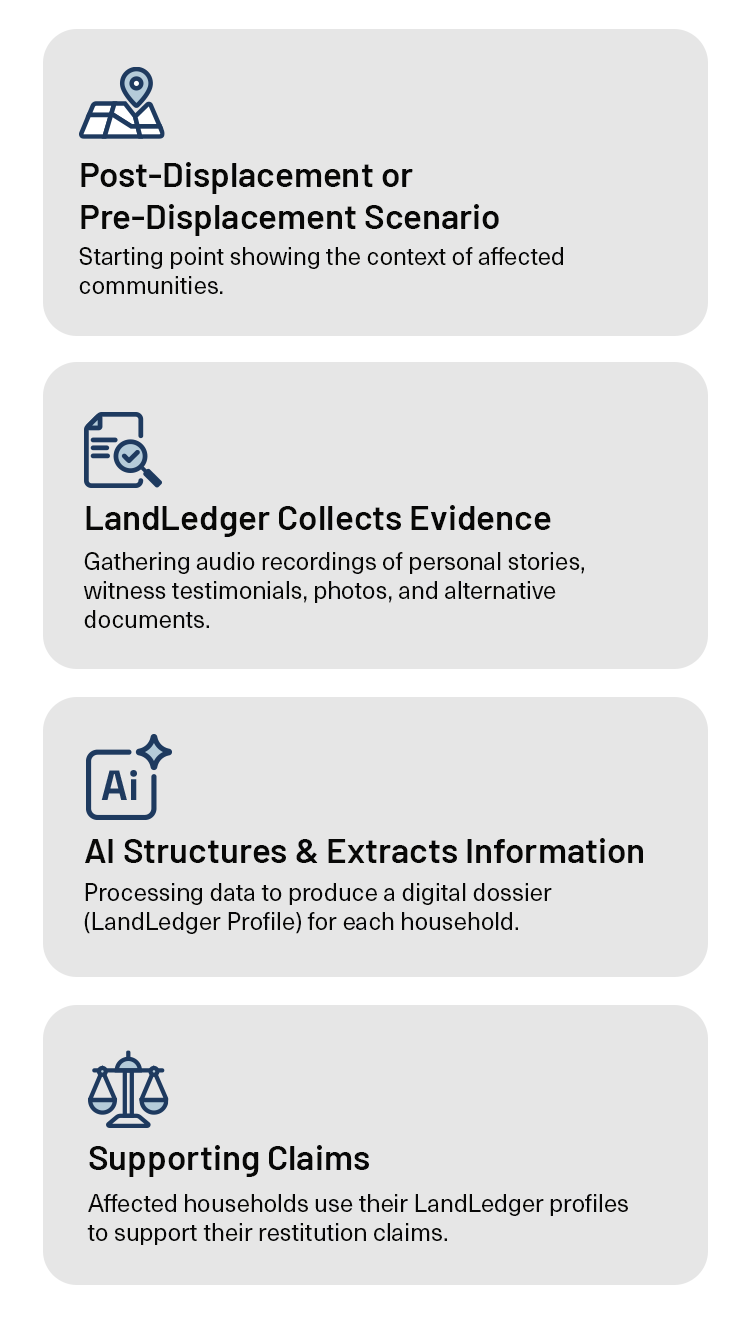
LandLedger combines simple field tools with advanced technology to capture how people relate to land — through their stories, evidence, and location. Enumerators or community members use a mobile app to document key details about a property: who lives there, how they came to occupy it, and what supporting materials exist. This can include photos of the land or house, scans of informal documents, maps, and even voice or video testimonies from the people involved.
Once collected, this information is organized and processed through an intelligent workflow that helps verify, structure, and store each record securely. Artificial intelligence assists in translating unstructured narratives into usable data — identifying patterns of tenure, linking stories to locations, and producing insights that humanitarian agencies can use for planning, targeting, and monitoring.
The resulting records can be consulted through a digital platform designed for both humanitarian practitioners and communities. For families, LandLedger provides a trusted digital space where their connection to land is recorded in their own words and safeguarded for the future. For agencies, it offers a unique layer of visibility into the realities of tenure on the ground, helping to design interventions that are better informed, more inclusive, and more accountable.
An Open Platform By Design
LandLedger was conceived as an open, shared platform. While it is developed and hosted by IOM, the intention from the outset has been for LandLedger to be usable by a wide range of humanitarian actors — including UN agencies, NGOs, government counterparts, and local partners. It is not designed as an IOM-only tool, but as a common digital infrastructure that can be adapted to different operational contexts and needs.
This open approach is reflected in LandLedger’s design choices. The platform’s visual identity and website use neutral colours and minimal institutional branding, emphasizing interoperability, partnership, and ease of adoption rather than organizational ownership.
The development of LandLedger has been made possible through funding from Innovation Norway, under its Humanitarian Innovation Programme, which supports the testing and scaling of new solutions to persistent humanitarian challenges.
Contact us to learn more about LandLedger